|
 |
|
| City &
Highlight Sightseeing ::
Persian Music |
|
|
|
|
 |
|
Where to Eat & Drink
in Shiraz
Restaurants & Teahouses
Always try a new local cuisines , you never
forget it. |
|
|
|
Vital Information
Money , Getting
around, internet, Health, Post, Visa,
Safety...etc
A few things to know before getting there |
|
|
|
|
|
|
MUSIC
INSTRUMENTS: |
|
|
|
| |
|
|
|
 |
 |
 |
| |

|
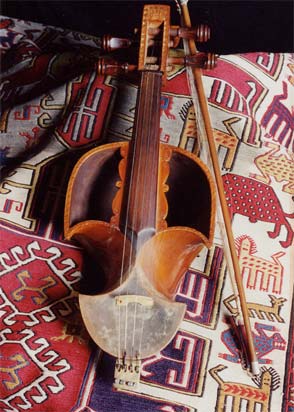
Derived
from the Persian words
kaman, 'bow' or 'arc',
and cheh, 'little' is
an ancient spiked fiddle
which is ancestor to most
modern European and Asian
bowed instruments. It can
now be found throughout the
area stretching from North
Africa to China. The
instrument's name varies
from region to region (e.g.
kamange, saz-e
Keshmiri, joze,
ghiczak), as does its
shape (it can be spherical
or cylindrical and have an
open or closed back).
The Iranian classical
kamancheh has a spherical
shape, its bridge resting on
the surface of a soundbox
covered by a membrane of
animal skin. The soundbox
has no standard size and can
be made entirely from one
piece of wood or from many
ribs. Its rounded body, made
from different kinds of wood
(e.g. mulberry, walnut, oak,
or maple), has a spike on
bottom to support the
instrument.
The kamancheh's four metal
strings are generally tuned
in fourths or fifths. The
instrument is held
vertically and the bow, made
of horsehair, moves
horizontally, with the
performer rotating the
instrument when he or she
moves from one string
to another.
 listen
to kamancheh listen
to kamancheh
|
|
|
|
 |
 |
 |
| |
|
|
|
|
|
|
| |
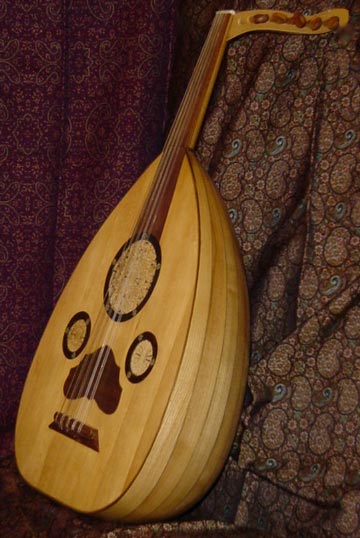 |
In Persian the word
"bat" means duck, while
"bar" is the duck's
breast. Lute is one of
the most ancient Iranian
instruments. It is
called "roud" by the
Persians and Arabs call
it "oud". Some believe
that lute has either
come from Hairah to the
west of the Euphrates
river near Mada'en, the
education center of the
Sassanid princes, or
from a city known as "Bab".
It has also been
referred to by many
other names including "oud",
"mozhar", "motar" and "keran".
Lute is considered to be
of Persian origin and
playing it has been
quite common in Iran
since the ancient times.
Once the Iranian lute
was taken to Saudi
Arabia, the Arabs,
likewise, started making
it from wood and called
it "oud". Its bowel is
very large and
pear-shaped. It has an
extremely short handle,
so that the cords mainly
extend along its bowel.
It has 10 cords or five
pairs of cord and is
played by a plectrum. A
chicken or peacock
feather serves as
plectrum. Lute produces
a dull, soft and
melancholy tone.
***************
Barbat
One of the branches of
guitar is called
Barbados or harper. With
the advent and growth of
Islam this genuine
Iranian musical
instrument traveled
around the world and is
being now used from
China up to Italy.
Statues unearthed from
Shush and dating back to
1500 years ago as well
as those excavated in
Haft Tappeh are proof of
the genuine Iranian
origin of this ancient
instrument.
listen
to barbat
|
|
|
|
|
|
|
|
|
|
|
|
| |
|
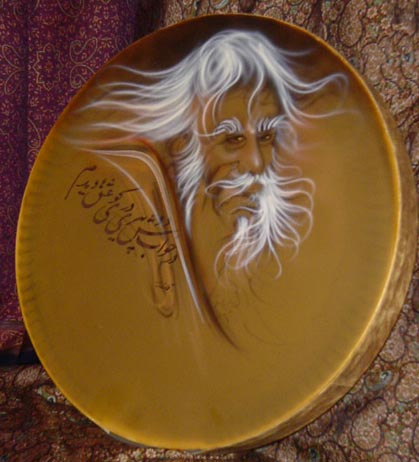
Daf is the large Persian
frame drum, is used in
Khangah (temple of
dervishes) during the
zekr (spiritual
chanting) ritual. Its
Pahlavi (pre-Islamic
Persian language) name
is Dap and Daf is the
arabicized version of
Dap. Many Persian poets
have alluded to the Daf
in their works; perhaps
the most famous one is
Molana Jalal-al-Din Rumi.
It has become very
popular these day and
is now integrated into
other styles of Persian
music. Indeed, the Daf
is becoming more popular
around the world.
***************
Daf
The antiquity of daf,
with the Pahlavi name
dap, goes to pre-Islamic
ages. Persian literature
shows us the importance
of this Persian frame
drum in Persian Sufi
music. Daf was
considered a spiritual
drum played in khanghahs
of Iran, particularly
Kurdistan. It should be
mentioned that similar
frame drums with similar
names are played in some
other countries such as
daf in India, tef in
Turkey, duf in Arabic
countries and dap in
Uyghuristan of China.
Thanks to some famous
daf players, daf
integrated into Persian
art music and it became
the second national drum
of Iran. The chief
national drum of Iran is
tonbak (the Persian
goblet drum). ToDay daf
is used in all genres of
music in Iran and in
this article I will give
a brief description of
different daf-s used in
different genres of
Iranian (Persian) music.
listen
to daf
|
|
|
|
|
|
|
|
|
|
|
|
| |
|
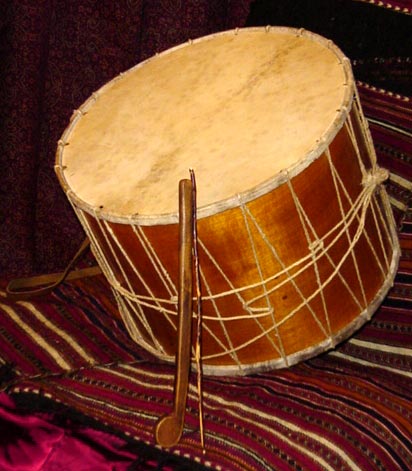
It is a big drum covered
by a piece of goat hide.
It is usually played in
accompaniment to sorna
in the villages,
agricultural areas and
plains and is made in
various sizes. Its
greater version is
commonly played in
Baluchestan. Dohol is
played by a rather long
wooden or osseous rod on
one side, while on the
other side tunes are
produced by plucking the
instrument with a few
small bones tied to the
fingers of the player's
other hand. The dohols
played in southern Iran
are cylindrical in shape
and their two bases are
covered by goat hide.
Dohols commonly played
in Fars province (Fasa)
are different in form
and quite similar to the
western instrument known
as timpani. Its body is
metallic and made from
copper, while its goat
hide is fastened by
leather band.
***************
Dohol /Davul:
A Davul is a large
double-skin drum. It
varies in sizes. One
side is made of goat
skin, the other side is
made of sheep skin. The
thin skinned is hit with
a light wooden stick or
twig, and the thick side
is hit with a tokmak(a
heavy stick used to play
bass sounds). The Davul
is generally played
outdoors accompanied by
a Zurna.
listen
to dohol
|
|
|
|
|
|
|
|
|
|
|
|
| |
|
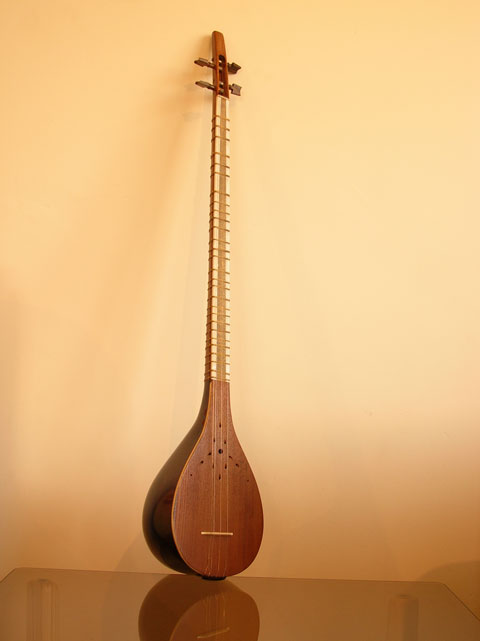
Setar is one of the
Iranian plectrum-type
string instruments,
which is plucked by the
player's forefinger's
nail. Sehtar or Setouyeh
is a three-cord
instrument, which was
converted into a
four-cord instrument
under the reign of the
Qajars. It is, in
general, an ancient and
gnostic instrument
usually played at the
gathering of dervishes
most often held at
Khaneqahs (monasteries
or houses of dervishes),
which makes the listener
feel high. In view of
its special vocal
features, Sehtar is
known as the instrument
appealing to the
listener's heart and the
Iranian musical
instrument ranking
second among Iranian
musicians. It is simpler
than other instruments
both in appearance and
the method of playing.
Its low tune,
compactness and
tenderness are the main
reason for its great
appeal in the course of
the past centuries. It
is made in various types
and sizes including
large, small, flat and
zir-abai. Tars are made
in two methods: Turkish
(in many pieces) and
scraped kasdani (in one
piece). Sehtar is
generally made from
berry wood, while at
some occasions that of
pear or walnut tree
might be used as well.
Its bowel is a
pear-shaped semi-sphere,
while its thin and
delicate handle is
tenderer than that of
other instruments.
listen
to setar
|
|
|
|
|
|
|
|
|
|
|
|
| |
|
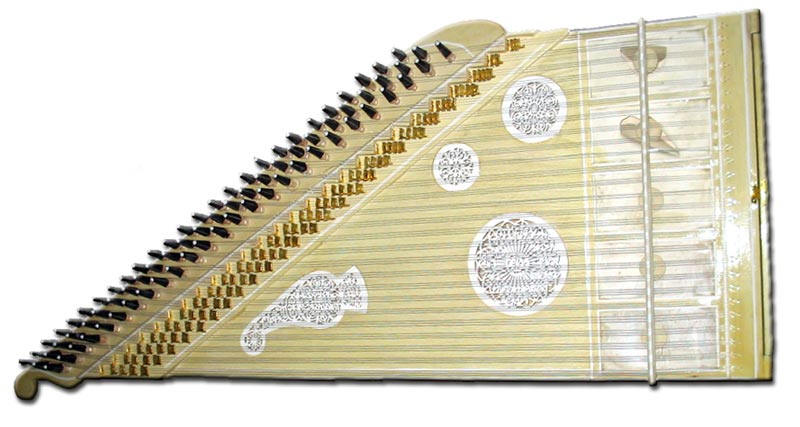
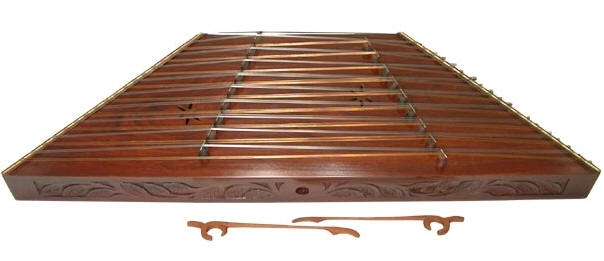
The santur is a persian
three-octave
wooden-hammered dulcimer
with seventy-two
strings(standard santour) which
are arranged on
adjustable tuning pegs
in eighteen quadruple
sets, nine (bronze) in
the low register, and
nine (steel) in the
middle register. The
Santur can be made from
various kinds of wood
(walnut, rosewood, betel
palm, etc.) depending on
the desired sound
quality. The front and
the back of the
instrument are connected
by soundposts whose
positions play an
important role in the
sound quality of the
instrument. Although the
santur is very old, it
was neither depicted in
miniatures, nor
presented in any other
medium until the
nineteenth century.
***************
The santur is a struck
zither in the form of a
shallow, regular
trapezoidal box. There
are several sound posts
inside the box, and two
small rosettes on the
top panel which help to
amplify the sound. The
santur has 72 strings,
arranged in groups of
four, i.e. each of four
closely spaced strings
are tuned to the same
pitch. Each group of
four strings is
supported by a
small,movable, wooden
bridge; the bridges are
positioned to give the
instrument a range of
three octaves.
***************
A Persian zither-type
stringed instrument
played with two delicate
wooden mallets. There
are 72 strings over two
sets of 9 bridges on
each side producing 27
diatonic tones, a little
over 3 octaves. By The
Art of Persian Music
***************
Santur (Dulcimer)
The strings are tuned
diatonically in groups
of three so each
neighboring three
strings will have the
same pitch. The number
of strings vary between
sixty-three and eighty
four. A santur with
sixty three strings has
twenty one pitches to
play on. Santur is one
of the most popular
instruments of Iranian
music. The dulcimer,
qanun, and zither are
related.
***************
Abstract: Dulcimer
(Santour) is an Iranian
musical instrument which
for the first time was
recorded in Assyrian and
Babylonian stone
inscriptions in 669 B.S.
Santour was christened
dulcimer in English
literature since 1400
A.D. and Nowadays more
than 10 types of
persian,Iraqi, Egyptian,
Indian and Turkish
dulcimers and are made
and played in other
countries.
Dulcimer was considered
an Ilamite musical
instrument in Iran in
the past because they
owned two types of harps
and flute and an
instrument that
resembled the dulcimer.
The Ilamite interest in
dulcimer can be noted
from stone inscriptions
in Izeh. Dulcimer has
been named with various
appellations during the
Iranian history. At
times it was called
Qanoon (in other words
the Qanoon and dulcimer
were called under a
single appellation)
whereas beside the fact
that they were both
string and beating
instruments, they had
many differences in
appearance and in method
of playing.
Santour or dulcimer is a
string instrument and
played by beating in the
Iranian music with very
ancient history. The
first time that dulcimer
made its appearance in
the ancient times was in
Assyrian and Babylonian
inscriptions in the year
699 before Christ. In
some ancient texts the
invention of dulcimer is
attributed to Farabi but
considering the names of
musical instruments
being used during the
Sassanian period as
related by Masoodi in
which dulcimer is also
listed, this attribution
does not appear to be
logical.
The term Santour has
been recorded by
different spellings in
various sources such as
Sontour, or Santir
(Arabic) or
Santour(san=100,tour=string).
In the beginning of the
middle ages the Santour
became popular and was
renamed according to the
tribal and linguistic
behaviors. As of 1400
A.D. Santour was
christened dulcimer (or
dalcimer) in the English
literature.
The Oxford Companion to
Music says in 1660 A.D.
Pepy registered the
dulcimer and reported
that its sound was heard
many years in Britain
and in London streets or
in dramatic plays.
According to that report
Hungarian, Romanian or
Bohemian gypsy dulcimer
players used to play
different types of
dulcimers.
Meanwhile in the English
translation of the Music
of the Bible a dulcimer
known as Yangkin which
is a Chinese
manufactured instrument
has been portrayed. This
dulcimer resembles the
present Day dulcimer
with slight differences.
Meanwhile its German
name is reported to be
Hack Bret. Fabrication
of piano was inspired by
dulcimer. The dulcimer
was gradually changed
into the original piano
and after a series of
modifications it emerged
into the present shape.
Nowadays more than ten
types of Santours or
dulcimers such as
persian,Iraqi, Indian,
Egyptian and Turkish
Santours are played in
other countries.
listen
to santour
|
|
|
|
|
|
|
|
|
|
|
|
| |

|
TAR (Plucked
Lute):
Tar is one of
the most ancient
classical Iranian string
instruments known for
its highly original and
traditional
characteristics. It has
six cords and is played
by a metal plectrum or
horn. The body, which is
the instrument's main
bowel, is usually made
in two wooden pieces (of
walnut or Indian berry
trees). The handle is
made separately and then
connected to the bowel.
The word "tar" was
originally obtained from
the Sanskrit word "tarah".
It was made for the very
first time with four
cords, while the number
was then increased to
five and eventually to
six. Its plectrum is
either made from metal
or a tough horn. Besides
the conventional tars,
two other types, alto (outar)
and soprano, have also
been made recently. It
should be noted that tar
is one of the most
complete musical
instruments.
***************
Iranians consider the
tar the "sultan of
instruments." Its
present form was
developed in 18th
century and has been the
choice of Persian
classical masters since.
It has a double-bowl
body of mulberry wood
with a lambskin face.
The fingerboard has 28
frets and the three
double strings are
played with a plectrum.
***************
The long and narrow
neck has a flat
fingerboard running
level to the membrane
and ends in an elaborate
box with nine wooden
pegs of different
dimensions, adding to
the decorative effect.
It has three courses of
double ";singing"strings
(each pair tuned in
unison: the first two
courses in plain steel,
the third in wound
copper), that are tuned
in fourths (C, G, C)
plus one ";flying"bass
string (wound in copper
and tuned in G (an
octave lower than the
singing middle course)
that runs outside the
fingerboard and passes
over an extension of the
nut. There are also two
pairs of shorter
sympathetic strings that
run under the bass and
over two small copper
bridges about midway the
upper side of the
fingerboard: their
tuning is variable
according to the piece
to be played and with
the performer's tastes:
(the tuning is somewhat
imprecise also because
both strings of the same
pair are tightened by
the same peg).
listen
to tar
|
|
|
|
|
|
|
|
|
|
|
|
| |
|
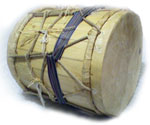
The Damam [damAm]
is one of the most
famous percussion
instruments in the south
of Iran particularly in
Booshehr [buSehr]
used in most of the
ceremonies of that
region.
The bowl of the Damam
has a cylindrical
construction covered by
skin on both sides and
fastened by straps and
ropes on the sides.
In general the Damam is
held on the ground and
played by both hands,
but sometimes it is
suspended from the neck
with straps during
performances.
Although this instrument
is particular to the
south of Iran, and one
can find instances of it
in India as well as
certain Arabic and
African countries.
******************
A large drum in one
piece, this instrument
is covered with
goatskin, which is
secured by a cord, made
from the fibers of a
date palm knotted seven
times. Dammam is played
with a wooden stick
and/or with the hand. In
the South of Iran it is
played in religious
ceremonies and stored in
Mosques.
listen
to dammam
|
|
|
|
|
|
|
|
|
|
|
|
| |
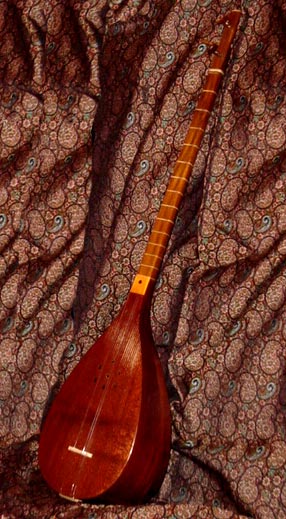 |
Tanbur / Tanbour /
Tanboor / Tambour:
The Tanbur, in the East
refers to a category of
popular lutes of various
sizes, proportions, and
sounds, with the common
characteristic that
their necks are longer
than their bodies. The
sober tones of the
instrument have
something immaterial,
abstract, and almost
ascetic about them,
predisposing the tanbur
to a serious and
celestial kind of music.
The tanbur was among the
instruments played at
the Court of the
Sassanides in the 5th
and 6th centuries, and
would later be used by
some Kurdish groups to
accompany the chants and
dances of their
spiritual gatherings.
For more information on
the tanbur, including
its repertoire, history,
typology, and playing
technique, please see
The Spirit of Sounds:
The Unique Art of Ostad
Elahi,
by Prof. Jean During
(Cornwall Books 2003).
***************
Tanbur / Tanbour:
Tanbour is one of the
few old musical
instruments which its
history goes back to
6000 years ago. It has
been clearly alluded to
in four ancient Iranian
treatises called "The
Asiran Tree", "Bondhesh
Encyclopedia", "Karnameh
Ardeshir Babakan", and "Khosro
Ghobadian and Ridak",
which are all among
authentic texts related
to the Pahlavi era of
ancient Iran. There are
also detailed
explanations of it in
such books belonging to
the Islamic era as "Moravej-ol-Mazhab"
by Masoudii, "Ehsa-ol-Oloum"
by Farabi, "The Great
Music" by Farabi, "Mafatih-ol-Oloum"
by Kharazmi, "Daneshnameh
Aalaii" by Avicenna, "Maghased-ol-Alha"
by Abd-ol-Ghader Maraghi,
and others. Farabi
believes that the music
comes in three types:
enlivening, impressing,
and dreamful and
considers the music
accompanied by song as
the most superior sort
of music. In his book
called "The Great
Music", he names two
types of Tanbour:
Khorasani Tanbour and
Baghdadi Tanbour. The
music played with
Tanbour is a special
one. The intervals,
rhythm and the quality
of tunes are such that
makes believe that the
music of Tanbour has
remained from the
ancient Iranian ones.
Researchers have found
many of the missing
links of dealing with
the ancient music of
Iran and the world. One
can find denomination
reasons for the names
Farabi has put on types
of music. The types of
Tanbour music are as
follows: 1- "Kalaam" or
"Haghaani" (meaning
Godly): Kalaams are
compositions with wide
rhythms, whose number
amounts to 72 "Maghaam"s.
One is not allowed to
play Kalaams in any
place or any company but
in "Jam Khaaneh"s. 2-
Chamber Maghaams (fitted
for parties): Certain
ones of them are called
"Houreh". 3- Virtual
(figurative) Maghaams:
This type of music is
lower than the two
previous ones in rank
and value as well as in
antiquity. Names of some
of Tanbour melodies:
Type 1 in Kalaam: "Tanemiri",
"Rejian Dalahoo", "Babanaghousi"
and etc. Type 2 in
chamber Maghams: "sahari",
"Majnouni", "Sartarz", "saroukhani",
"Tarzerostam", "gharibi",
"Hejrani", "Ghatar", "Gol
va Darreh", and etc.
Type 3 in virtual
Maghams: "Jeloshahi",
"Khan Amiri", "Savar
Savar", "Jenkera", "Samaa"
and etc.
Tanbur / Tanbour:
The tanbur is the
ancestor to most
long-necked, plucked
stringed instruments.
Its pear shaped belly is
normally carved out of
one piece of mulberry
wood with a long neck
and fourteen gut frets.
Some modern tanburs are
made of bent ribs of
mulberry wood. The sound
board, 3-4 millimeters
thick, is also made of
mulberry wood which has
numerous small holes for
better resonance.
The tanbur has a unique
playing technique by
which the strings are
strummed with the
fingers of the right
hand to produce a very
full and even tremolo
called shorr (literally
meaning the pouring of
water). This technique
along with various kinds
of plucking, usually
with the index and pinky
fingers, enables the
musicians to produce
different effects and
various rhythmic
accentuations which
imitate the natural
sounds of their
environment such as a
running stream, a water
fall, a bird chirping or
a horses' gallop, all
translated into musical
rhythms and sounds.
The ancient tanbur used
to have two silk or in
some instances gut
strings tuned in 4th or
5th, similar to the
dotar (meaning two
stringed), its close
relative widely used in
Eastern Iran. It has
also been regarded as
the tanbur of Khorasan
in literary texts.
Although these two
instruments share a
similar history and are
basically the same, they
have developed their own
repertoires, playing
techniques and
functions. According to
the master instrument
maker Ustad Mehdi
Kamalian the name tanbur
is taken from the word
tandur or tanur, meaning
clay oven, as early
instrument makers dried
tree trunks chosen to
carve the belly in
tanours for several
hours in order to
perfect the sound.
Gradually the instrument
took on the name tanbur.
The present tanbur has
three strings and covers
the range of one octave
and two notes. The lower
pair of strings, made of
steel, are tuned in
unison normally anywhere
from a (flat) to (b) and
are fingered together
functioning as the
melody strings. The top
string made of copper or
brass, slightly thicker,
tuned in lower fourth or
fifth, functions as a
sympathetic string with
occasional fingering by
the thumb.
The tanbur has always
been considered a sacred
instrument associated
with the Kurdish Sufi
music of Western Iran
and it is believed that
its repertoire is based
on ancient Persian
music. Up until the last
fifty years this
instrument was used only
during djamm gatherings
(devotional or liturgic
ceremonies) of the
Ahle-Haqq (the people of
truth), followers of a
particular Sufi order.
By Keyhan Kalhor
***************
Tanbur / Tanbour:
Tanbour is the oldest
and most genuine Iranian
musical instrument and
Nowadays nearly half of
the people around the
world are acquainted
with this ancient
Iranian instrument and
are using it in
different parts of the
world under different
names. This ancient
instrument with its
heavenly and ravishing
sound is used in many
countries specially in
China, Iran, Turkey,
Iraq, the Commonwealth
of Independent States
(CIS) such as Azarbaijan
and Armenia and other
countries. It is
specially revered by
native Iranians who
during their collective
or individual prayers
use the tanbur to
commune with God and
believe it helps them to
approach the Almighty.
From ancient times the
tanbur was played in
Iran and specially in
western regions,
Khorasan province and
Persian Gulf and
Lorestan suburbs as well
as Kaneqahs (hermitages)
for praise of God and
prayers. We shall first
of all refer to the
historical evolution of
Tanbur by Husseinali
Mallah, the well known
research in his
Dictionary of Musical
Instruments; Mehdi
Setayeshgar in his
Glossary of Iranian
Music; and Alireza
Feizbashipour, a
researcher and player of
tanbur. Then we will
zoom on the method of
election of the wood for
the tanbur and its
fabrication.
***************
Tanbur / Tanbour:
Is the oldest and most
genuine Iranian musical
instrument and Nowadays
nearly half of the
people around the world
are acquainted with this
ancient Iranian
instrument and are using
it in different parts of
the world under
different names.
This ancient instrument
with is heavenly and
ravishing sound is used
in many countries
specially in China,
Iran, Turkey, Iraq, the
Commonwealth of
Independent States (CIS)
such as Azarbaijan and
Armenia and other
countries. It is
specially revered by
native Iranians who
during their collective
or individual prayers
use the guitar to
commune with God and
believe it helps them to
approach the Almighty.
From ancient times the
guitar was played in
Iran and specially in
western regions,
Khorassan province and
Persian Gulf and
Lorestan suburbs as well
as Kaneqahs (hermitages)
for praise of God and
prayers.
We shall first of all
refer to the historical
evolution of Tanbour by
Husseinali Mallah, the
well known research in
his Dictionary of
Musical Instruments;
Mehdi Setayeshgar in his
Glossary of Iranian
Music; and Alireza
Feizbashipour, a
researcher and player of
guitar. Then we will
zoom on the method of
election of the wood for
the guitar and its
fabrication.
Tanbour, as described in
dictionary of musical
instruments by
Husseinali Mallah
Tanbour, is a branch of
Iranian family of
musical instruments.
After providing a brief
history about the guitar
Mallah says: "When this
sound compartment of the
Tanbour gradually became
elliptical in shape one
end of the oval
instrument was
lengthened and narrowed
little by little and
when it was called
harper or aggaloch that
its handle had grown
longer and the
resounding bowl of the
instrument had grown
bigger. This meant the
invention of a new
family of Tanbour. It
has been called by
different names in
various regions
including Tanbour in
Iran."
In the opinion of Farmer
with the spread of the
Islamic religion around
the world the impact of
this Iranian musical
instrument spread in
every corner and even in
such remote regions
where Islam had failed
to penetrate i.e., to
shores of the Atlantic
Ocean in the west, to
Siberia in the north and
to confines of India and
islands located in the
eastern wing of India.
Tanbour known as
Tanboureh in Iran's
neighboring countries
gradually arrived in
China and changed its
name into Tanpoula. In
Greece it was called
Tampouras. >From Greece
the guitar traveled to
Albania and was renamed
Tamoura. In Russia it
was christened Dumbra
and in Siberia and
Mongolia they called it
Dumbra or Dumbereh.
However during the
Byzantine empire they
called it Pandora and
other European tribes
became acquainted with
that instrument through
Byzantine. The
instrument is popular in
Turkey and India as
well.
In Reyman musical
dictionary, reference is
made to Tanbour (p.
1319): "Making of
tambourine was an
Iranian and Arab art and
the instrument is from
the family of aggaloch."
Reyman believes that the
instrument was called
Tambouri in India which
undoubtedly was the same
Iranian Tanbour. In
Italy it is called
Tamburo and in Caucasus
it is named Tampour. The
Armenians also call it
Tambour.
The Graw Musical
Dictionary says the term
tambourine was changed
into different
appellation in the
difficult dialects of
various nations. The
Encyclopedia Britannica
says Tanbour is a
long-necked lute played
under various names from
the Balkans to Northwest
Asia. Closely resembling
the ancient Greek
pandoura and the long
lutes of ancient Egypt
and Babylon, it has a
deep, pear-shaped body,
a fretted neck, and 2 to
10 double courses of
metal strings fastened
with front and side
tuning pegs without a
pegbox.
The Tanbour has remained
popular since medieval
times. Its derivatives
include the Greek buzuki,
the Romanian tamburitza,
and the Indian sitar and
tambura.
Tanboura is an
instrument invented in
the East from the family
of the aggaloch with a
long handle and two or
three strings which is
played by the fingers.
The most ancient trace
of this instrument were
the images discovered in
Bani Yunos and Keyvan
hills, in Mosul. From
these images one can
deduce that these
instruments closely
resembled the present
guitar. They held a very
long and thin handle
with a delicate bowl
with a proper covering.
Statutes unearthed in
Shush belong to 1500
years B.C. and those
discovered at Haft
Tappeh display the
antiquity of the
instrument.
Jule Rouyaneh writes:
Farabi, a writer of the
tenth century A.D., has
carefully described the
musical instruments of
his time such as
aggaloch, guitar,
Khorassani Tanbour and
Shirazi tanbour and has
given a precise account
of the method of
employment of fingers on
the strings by numbering
the fingers. Among
tambourine those used in
Baghdad and Damascus had
different divisions of
notes.
In Zax, which is a
complete dictionary of
musical instrument, it
is said: The Persian,
Kurdish and Hebrew
guitar resembles the egg
with a long handle and
in fact the guitar
fabrication was the
first step by mankind to
develop and refine such
instruments. As a whole
one can study the
changes in the outside
appearance of the
tanbour from the
Assyrian age to present
time. Nowadays guitar
belongs to a large mass
of human community.
Etymological root of
Tanbour was pandora
Tanbour is called by
different nominations in
various parts of Iran
such as Khorassani
Tanbour, Mizani Tanbour
or Baghdadi, Turkish or
Shervanian Tanbour. But
records says the tanbour
had the following
classification in
ancient times: It is a
string instrument It was
played by finger nails
of three right hand
fingers At the beginning
it possessed only a
single string It was
divided into two types;
one type was covered by
a curtain and the other
was without any covering
In appearance it
resembled double string
(Chagour) It had surely
a receiver and a bridge
In his Glossary of
Musical Terms, volume 1,
Mehdi Setayeshgar thus
describes the tanbour:
Tanbour is a string
instrument set to a long
handle and a bowl and is
played by beating of
fingers.
Tanbour has existed in
different periods of
history and was the most
popular string plectrum
instrument. Formerly a
pear-like tanbour
prevailed in Iran and
Syria; then it traveled
to Turkey and Greece and
from there to the West.
Nowadays one can sea
different models of
native tanbour with
longer handles or bigger
bowls or much more
curved than the Setar
(three string guitar)
which possesses two,
three or four strings
with octave spaces
divided into scales.
Tanbour is played by
hand which points to the
close relation between
the tanbour and double
string guitar like
Iranian instrument.
Tanbour is used in the
assembly of tanbour
players, athletes and
dervishes by reciting
religious verses. Ibne
Khordad has referred to
singing by tanbour in
Rey, Tabrestan and
Deylam, says
Setayeshgar. He says
Farabi has described
Mizani or Baghdadi
tanbours and their
method of tuning. These
possess two strings and
were famous as Turkish
tanbours. He has also
described the Shervanian
tanbour and the images
in Nineva. He has
described the Baghdadi,
Turkish, Khorassani,
double string,
Shervanian, Tambourak,
Tamouraki, Moroccan,
Mongolian and Tanbireh
or guitars and their
methods of use.
In his expertise
research of music
Alireza Feizbashipour is
speaking about tanbour
and the people west of
Iran.
"Based on beliefs and
documents as well as
examination of various
musicians and the
different types of
tanbours used by the
Kurdish tribe and people
west of Iran, one can
conclude that this
tanbour was the same
ancient Iranian tanbour
or guitar which has been
referred in ancient
books and images as well
as in literary texts. He
refers to each of the
following tanbours and
their method of use:
1. Baghdadi, Turkish,
Khorassani, double
string, Shervanian,
Tambourak, Tanbouraki,
Moroccan, Mongolian,
Tanbireh. In his
masterly and expertise
research about Iranian
music, Alireza
Feizbashipour says based
on the beliefs and
existing records and
examination of music and
the different ranks
among the Kurdish tribe
and the folk living west
of Iran, one can
conclude that tanbour
was a derivation of the
same ancient tanbour
which has been spoken in
ancient books, images or
literary texts.
He mentions Barieh,
Tarze Rostam, Majnooni
and Jongara ranks as the
ancient ranks which were
transferred from ancient
times to the present
times from generation to
generation. He seems to
have mistaken Barieh
rank with Barbod rank.
The difference between
the ranks (Dastans) in
that tanbour nearly
resembles the interval
between 12 notes Dastans
known as Fors
(introduced by Farabi).
He says two models of
tanbours were popular in
Kermanshah in the Gouran
and Safeh regions, and
it was popularly played
in the Safeh region
among Alavians and the
mountain skirts of
Zagros and the elders
and leaders of these
regions were completely
familiar with the
instrument.
The tanbour is equipped
with two basic tuning
instruments which if
used in a scientific
manner in one of the
turning knobs the base
wire is symmetrical with
the fifth interval known
as Chiereh and in the
other the base wire
harmonious with the
fourth interval known as
Dang. Both these tuning
knobs bear their own
specific names and the
names attributed to two
specific ranks in the
tanbour. The first
interval or the base
wire tuning knot forms
the Sheir Amiri interval
with the fourth
interval. The second
tuning knob which links
the base wire to the
fifth Vakhan is known as
Kook Tarz and they are
always called with these
appellations. In
different regions other
names are given such as
Borz and Tarz and Haft
Dassan (Haft Dastan) and
Panj Dassan (panj dastan).
Borz is the same Sheikh
Amir tuning and Haft
Dastan and Tarz is the
tarz tuning knob called
Panj Dastan. One must
note that these ancient
ranks for tanbour were
mostly used by Tarz
tuning knobs and is far
ancient. Commenting on
the musical notes played
by tanbour Feizbashipour
says, the tanbour music
is specific and
exceptionally melodious
compared to other music
in Kermanshah. The
specific features of
that music such as the
interval, weight and the
cadence of the lay is
such which leads us to
believe that the tanbour
music is a genuine
ancient Iranian music to
the extent that a
careful examination of
such music can shed
light on certain
features of old Iranian
music.
It must be noted that
beside conducting music
in ranks the tanbour is
played in two other
forms as well. One of
them is used for elegies
extemporaneous plays on
the basis of the tanbour
ranks and the other is
to play pieces composed
by outstanding masters
of music. After group
music became popular
such type of tanbour
playing has increased
but regretfully many
such pieces are
unrelated to tanbour
music and are void of
cultural or artistic
value for the tanbour or
guitar.
Playing Tanbour and
popular plectrums The
player of tanbour sits
on his two knees of
squats on the ground and
places the bows on his
leg so that the facing
stands vertical. On the
other he places the
handle in little forward
and high and the right
hand embraces nearly the
back and face of the bow
and plays the instrument
by beating the strings
by his hand.
The plectrums The most
important and beautiful
plectrum in tanbour is
called Shor or Shaneh
which is sometimes
changed to Tarz by some
tribes. Shor means
serial and consecutive.
In the Shor plectrum
four fingers stand
tangent on against the
face and he repeats his
beating from bottom to
top on the strings. Of
course some players
resort to their thumb
and play with five
fingers. In this
plectrum the edge of the
fingers is used
obliquely from the base
and it produces
beautiful sounds like
the fall of rain or
waterfall. The speed of
the plectrum can be
controlled by the
players. Pas Shoryar is
another plectrum for the
tanbour which is played
by four fingers unlike
Shor. To play one must
stretch his four fingers
on the strings from top
to bottom. Separated Tak
Variz and two Taks, etc.
are other types of
plectrums for tanbour.
Here we will refer to
two ranks in tanbour as
suggested by Alireza
Feizbashipour.
Flower and earth Flower
and earth are two
valuable and ancient
ranks specially used by
tanbour which is a
singing musical
instrument and echoes
the pain and suffering
from the bottom of the
heart or the loss of a
dear relative. Flower
and earth in Uramani
Kurdish language means
flower in the earth,
flower fallen on the
earth and dead flower
buried in the earth.
This rank was played and
is still played as elegy
to mourn the departure
of a beloved one. During
mourning ceremonies or
burial of their dead
this tribe use a tanbour
accompanied by a solo
singer or group singers.
Flower and earth is one
of the branches of elegy
played by tanbour or the
Iranian guitar, but
being a theoretical rank
it is not used in the
above mentioned
ceremonies. In mourning
ceremonies two dialectic
ranks of the tanbour
known as Fani Fani is
used. Flower and earth
is mostly sung by
natives of Hozeh Gouran
or Karand. Its rhythm is
produced by seven
plectrums which is
called Sepa (three steps
or tripod) in Kurdish
language.
Seyed Vali Husseini
Gahvareyi and Seyed
Ghaem Afzali Shah
Ebrahimi are well known
players of the flower
and earth ranks. Tarze
Rostam Tarze Rostam
(like Rostam) is another
ancient tanbour rank. It
is a beautiful and
meaningful epic song and
echoes human thoughts
which appeals to
Farvehar (the holy
spirit of the dead) or
the angels of salvation
to remove oppression.
Here Rostam is a
benevolent knight who is
believed to be a player
of tanbour himself and a
pioneer among all
lovers. In this melody
they call on Rostam to
chain and jail the evil
Div (Satan) and to
rescue and protect Iran
from degradation.
This rank is
specifically used in
Gouran and played by
Kouk Borz. Of important
players of such pieces
one might refer to Seyed
Mahmood Alavi and Seyed
Vali Husseini and Taher
Yarveissi, his able
student. In the past a
man called Birkhan
Zardehi used to play
this rank in an
excellent manner.
Text by Iran Heritage
listen
to tanbur
|
|
|
|
|
|
|
|
|
|
|
|
| |
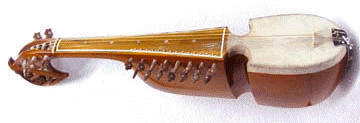 |
The word Rebab [robAb]
is an Arabic term that
can be translated as
bowed string instrument.
Dating back at least to
the 8th century, the
Rebab has been closely
associated with Islamic
culture and is thought
to be the earliest
ancestor of the
contemporary violin.
While its roots are in
Persia, the Rebab's
influence has reached as
far east as Indonesia
and west to regions of
Europe and Africa. Its
diffusion is closely
tied to the growth of
the Islamic world and
the development of
extensive trade routes
after the 10th century.
As part of the generic
'lute' family, there are
two basic types of Rebab:
wooden fiddles with
pear-shaped or elongated
bodies, and spiked
fiddles, named for the
extension or spike on
the bottom of the
instrument on which it
stands when played.
Generally, both styles
have 2 or 3 gut or other
strings.
Spike-fiddle Rebabs used
in the Javanese gamelan
are made from wood, or
sometimes from a
hollowed, half coconut
shell covered with hide.
This body is attached to
a long, narrow wooden
neck which has no frets;
instead, the fingers of
your left hand become
moveable bridges. These
instruments ornament the
melodic line, creating a
dialogue with the
singers.

listen to robab
|
|
|
|
|
|
|
|
|
|
|
|
| |
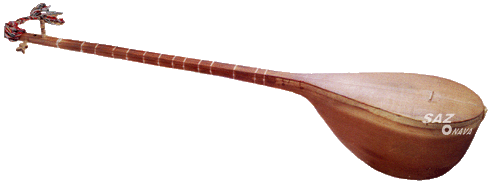 |
he dotar ( meaning ``two
strings'' in Persian),
is an excellent
instrument coming from a
family of long-necked
lutes and can be found
throughout Central Asia,
the Middle East and
North East of China. Its
ancestor is probably the
"tanbur of Khorasan" as
depicted by Al Farabi
(10th century) in his
essay Kitab~Al-Musiqi
Al-Kabir.
In Iran, the dotar
is played mainly in the
northern and eastern
parts of Khorasan as
well as among the
Turkmen of Gorgan and
Gonabad. The instrument
is the same but its
dimensions and the
number of its ligatures
differ slightly from
region to region. Two
types of wood are used
in the production of the
dotar. The
pear-shaped body is
carved out of a single
block of mulberry wood.
Apricot or walnut wood
is used to make its
neck. It has two steel
strings, which in the
past were made of silk
or animal .
The dotar is
tuned in fourth or fifth
intervals. The frets,
made from animal
intestines in the past,
are Nowadays fabricated
from nylon or steel
which have the advantage
of being more resilient
and less expensive. They
are placed in chromatic
progression.
The technique for
playing the dotar
consists of plucking the
strings without a
plectrum, following a
descending and an
ascending movement which
involves the index and
often several other
fingers. The music is
ornamented by the rapid
repetition of notes
(tremolo). Often, in
order to fortify the
fingers, they are soaked
in henna.

listen to dotar
|
|
|
|
|
|
|
|
|
|
|
|
| |
|
|
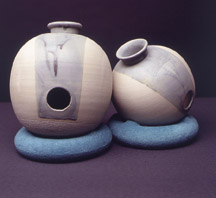
Fascinated by the
possibilities and the
various pitches of the
usual Udu, Behnam Samani,
a master in Persian
percussion, created a
new form, which still
keeps the soft round
harmonious bass tones
yet opens the way to new
inspiration and
experience.
Based on the African Udu-Drum
from Nigeria the
Zarbang-Udu contains a
very large dynamic range
of sound, having two
side holes (or one) and
a membrane of natural
skin placed in between
them (beside it). This
way the membrane and the
hole/s can be played
with one or two hands at
the same time.
Depending on the
finger-technique the
sound of Conga, Tombak,
Darbukka or even Indian
Tabla come alive,
besides a kaleidoscope
of humming, smacking,
and plocking tones
challenging creativity!

listen
to udu
|
|
|
|
|
|
|
|
|
|
|
|
| |
|
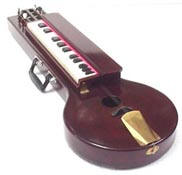
the benju, a small
oblong zither with a
typewriter-like
keyboard, derived from
the spinet and dulcimer.
Baluchi people doubled
its size (to one metre
in length), improved it,
and created a playing
technique which both
wonderfully reproduces
the finesse of
professional music, and
at the same time, allows
a rhythmic drone similar
to the tanburag. Its
bright timbre matches
quite well with that of
the sorud, and some
pieces even sound better
on the benju than they
do on any other
instrument. This
metamorphosis is mainly
due to the work of Jome
Surizehi.
The main string of the
benju is double. On
either side of it,
accompaniment strings
have been placed as
follows: (C-G) / C C /
(G-C) - in relative
pitches. Its tessitura
spans over two octaves
and one tone; the
chromatic scale is
obtained from a keyboard
with twenty five to
thirty two round keys.
Best used as a solo
instrument, the benju
also suits singing, but
is rarely used in epic
pieces.
listen
to benju
|
|
|
|
|
|
|
|
|
|
|
|
| |
|
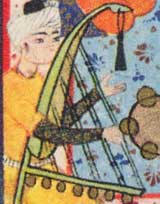 |
The musical instrument
most often depicted in
art,both ancient and
medieval,and also the
one most celebrated in
kiterature is the chang.
This harp is clearly
represented in the
Elamite relief of
malamir,dating from the
seventh century ,which
portrays three
musicians:one is playing
a triangular harp
and one a cithara or
lyre, the third
instrument,
unfortunately, has
deteriorated beyond
recognition. Several
boatloads of harists
arefound accompanying
the boar hunters in the
sassanian rock carving
at Tag-i Bustan. The
chang became famous in
literature. Two well
known poets were also
noted harpists,
Rudaki,who lived during
therule of the samanids
at the end of the ninth
century and beginning of
the tenthand farukhi of
the eleventh century.
The harp depicted in
miniatures of the
sixteeth and seventeenth
centuries was a large
triangular instrument
whose body must have
been over a metter in
lenght.
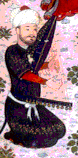
Accordingtoartists,representations,the
player supported the
lower frame on his knee
,and the body,curved at
the upper end to form a
scroll was often
elaborately
decorated.The number of
strings varied according
to the artists,but
usually approached
thirty.The chang is
extinct as a musical
instrument. but it does
continue its importance
as a motive in the
visual arts and is still
found in contemporary
paintings,metal work and
printed cloth.
|
|
|
|
|
|
|
|
|
|
|
|
| |
|
|
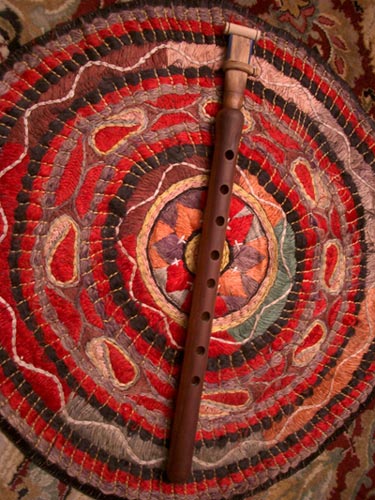
The doneli is a double
end-blown flute. It is
also played in Sindh (algoza)
and in Rajasthan (satara).
The Sindhi masters of
this instrument are said
to all be of Baluchi
descent, as is Khamisu
Khn. But still, the
doneli is a rare
instrument. It is
usually played solo, and
is used for the whole
repertoire, both profane
and ritual, with the
exception of the
shervandi. Some people
go into a trance
exclusively to the sound
of this instrument. The
right-hand flute, known
as the male, has seven
holes (producing a more
or less chromatic
scale); it is used to
play the melody, and is
supported by the
left-hand flute, called
the maiden, which has
eight holes and only
produces a drone. By
plugging up the holes
with wax, the sound of
the drone may be altered
according to the mode or
the range of a given
piece. The very accurate
turning of the flutes in
relationship to one
another is obtained by
sticking a piece of wax
(or date palm fruit)
onto the bevelled edge
of the mouth piece. To
play the doneli, the
musician places both
flutes to his mouth, the
left-hand one upside
down and blows
continuously (circular
blowing). But blowing
regularly is not enough.
Particular accents,
which distinguish the
doneli from other
instruments played with
circular blowing, enable
the flautist to ornate
the melody with
appogiaturas which sound
like a supplementary
part added to the drone.
Any sorud piece or song
can be played on the
doneli, but with its own
style, and, sometimes,
intervals. For reasons
of tessitura and tuning,
these two instruments,
sorud and doneli, are
rarely heard together.
The doneli is
essentially played solo.
It can even be played
without tanburag
accompaniment.
|
|
|
|
|
|
|
|
|
|
|
|
| |
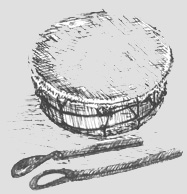 |
The Tas [tAs]
is another percussion
instrument of
Kurdistan's Dervishes
played alongside the daf
at the climax of the
Sama.
The Tas is constructed
from a metallic bowl and
covered with skin,
stretched tight by belts
on the sides of the
bowl. The Tas is placed
on the ground and played
by two wide leather
straps.
This instrument is also
played during eclipses
and ritual ceremonies
for rain on the rooftops
in Kurdistan.
|
|
|
|
|
|
|
|
|
|
|
|
| |
|
|
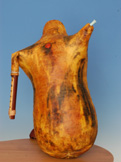
Dozaleh [dozAle]
is one of the old folk
wind instruments of Iran
which is used in mirth
celebrations.
Abu Nasr Farabi had
called it
Mezmarol-Mosana or
Mozdavadg [mozdavej]
(married!).
Dozaleh has a sound like
Neyanban [neianbAn]
(bagpipe), but to some
extend more clear and
lower.
It is played in Khorasan
[xorAsAn],
Kermanshah [KermAnSAh],
and mostly in Kurdistan.
In some different
dialects it is called
Zanbooreh [zanbureh].
|
|
|
|
|
|
|
|
|
|
|
|
|
|
|
| Suggest your comments about nearby Sightseeing |
Private and group tours Tours , also Accommodation reservation services are available at
www.PersiaTours.com for further information , please contact us.
Use the following keywords to find this page online:
Iran Music, Travel Iran Music , Iran Music
vacations, Iran Music tourism, Iran Music hotels,
deals, Iran Music historical travel tour, Iran
Music visitors guide, Iran Music advice, Iran
Music map, Iran Music pictures, Iran Music
information, Iran Music ratings, Iran Music
reviews, Iran Music airport, Iran Music weather,
Iran Music things to do, Iran Music attractions,
Iran Music cultural tours iran , Iran Music
travel to Iran, Iran Music Iran tours, Iran Music Iran
touring, Iran Music Iran tourism, Tour to Iran Music , Tours
in Iran Music , Iran Music tour operator, Adventure tours in
Iran Music , Business Travel to Iran Music , Business Trip to Iran,
Archaeology tour in Iran Music , Pilgrim tours in Iran Music ,
Persian tours Iran Music , cultural tours in Iran Music ,
geographical tours in Iran Music , Persia, tour to Persia, Trekking
tours in Iran Music , hunting tours in Iran , historical tours in Iran ,
climbing tours in Iran Iran Music Plucked Strings :
Barbat - Setar - Taar - Dotar Robab - Tanbour -
Chogur - Chang - Tambireh Percussive & keyboard
Strings: Santour- Benju Bowed Strings : Gheychak -
Kamancheh Wind Instruments : Sorna - Balaban - Ney
Ney-anban - Dunali - Dozaleh Percussion Instruments:
Daf - Tombak - Dohol Dammam - Udu - Tas - Naghara -
Zang -Tabla Dotable - Other percussion instruments |
|
|
|
|
|
 |
|