











Susa
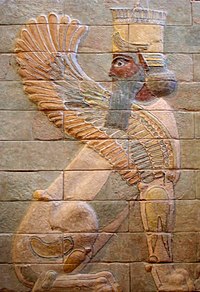
Susa (in Persian: شوش Shush) is a city in the Khuzestan province of Iran. It had an estimated population of 64,960 in 2005.[1]
History
Susa (Biblical Shushan; also Greek: Σέλεύχεια, transliterated as Seleukeia or Seleukheia; Latin Seleucia ad Eulaeum; modern Shush, coordinates: ) was an ancient city of the Elamite, Persian and Parthian empires of Iran, located about 150 miles east of the Tigris River in Khuzestan province of Iran. As well as being an archaeological site, Shush is also a lively village due to the devotion of Shi'a Muslims and the Persian Jewish community for the prophet Daniel.
Susa is one of the oldest-known settlements of the region, probably founded about 4000 BCE; though the first traces of an inhabited village date back to 7000 BCE. Evidence of a painted- pottery civilization dates back to 5000 BCE. In historic times, Susa was the capital of the Elamite Empire. Its name originates from their language; it was written variously (uan, uun etc.) and was apparently pronounced uən. uan was invaded by both Babylonian Empires as well as the Assyrian Empire in violent campaigns. After the Babylonian conquest, the name was misunderstood to be connected with the Semitic word uan, "lily."
Susa is mentioned in the Ketuvim of the Hebrew Bible, mainly in Esther but also once each in Nehemiah and Daniel. Both Daniel and Nehemiah lived in Susa during the Babylonian captivity of Judah of the 6th century BCE. Esther became queen there, and saved the Jews from genocide. A tomb presumed to be that of Daniel is located in the area, known as Shush-Daniel. The tomb is marked by an unusual white, stone cone, which is neither regular nor symmetric.
A tablet unearthed in 1854 by Henry Austin Layard in Nineveh reveals Ashurbanipal as an "avenger", seeking retribution for the humiliations the Elamites had inflicted on the Mesopotamians over the centuries:
"Susa, the great holy city, abode of their Gods, seat of their mysteries, I conquered. I entered its palaces, I opened their treasuries where silver and gold, goods and wealth were amassed...I destroyed the ziggurat of Susa. I smashed its shining copper horns. I reduced the temples of Elam to naught; their gods and goddesses I scattered to the winds. The tombs of their ancient and recent kings I devastated, I exposed to the sun, and I carried away their bones toward the land of Ashur. I devastated the provinces of Elam and on their lands I sowed salt."[2]
The city was soon, however taken back by the Achaemenid Persians under Cyrus the Great in 538 BCE. Under Cyrus' son Cambyses II, the capital of the empire moved from Pasargadae to Susa.


The city lost some of its importance when Alexander of Macedon conquered it in 331 BCE and destroyed the first Persian Empire, but after Alexander's vast empire collapsed upon his death, Susa became one of the two capitals (along with Ctesiphon) of Parthia. Susa fell to the Seleucid Empire during which it was renamed Seleukeia. Susa became a frequent place of refuge for Parthian and later, the Persian Sassanid kings, as the Romans sacked Ctesiphon five different times between 116 and 297 CE. Typically, the Parthian rulers wintered in Susa, and spent the summer in Ctesiphon.
The Roman emperor Trajan captured Susa in 116 CE, but soon was forced to withdraw, due to revolts in his rear areas. This advance marked the greatest eastern penetration by the Romans.
Susa was destroyed at least twice in its history. In 647 BCE, the Assyrian king Assurbanipal leveled the city during the course of a war in which the people of Susa apparently participated on the other side. The second destruction of Susa took place in 638 CE, when the Muslim armies first conquered Persia. Finally, in 1218 CE, the city was completely destroyed by invading Turkic Mongols. The ancient city was gradually abandoned in the years that followed.
Contemporary Susa
Recently, the site has been threatened by illegal excavations, garbage dumping by the local authorities and a planned bus depot on unexcavated territory nearby.[3]

Ashurbanipal's
brutal
campaign
against
Susa is
triumphantly
recorded
in this
relief
showing
the sack
of Susa
in 647
BCE.
Here,
flames
rise
from the
city as
Assyrian
soldiers
topple
it with
pickaxes
and
crowbars
and
carry
off the
spoils.
|

Anthropoid
sarcophagus
|

Lion on
a
decorative
panel
from
Darius I's
palace
|

Islamic
art:
Vase
with
palmtrees,
8th9th
centuries
|

Tomb of
Daniel,
Susa, is
a
popular
attraction
in
Iran's
Jewish
community
|


